Auge um Auge (IV.)
Im März des folgenden Jahres veranstaltete der konstitutionelle Verein eine Debatte in Innsbruck, in welcher der Hauptzollamtskontrolleur Trampler für die Todesstrafe argumentierte, der bereits bekannte Prof. Geyer, sowie der Oberlandesgerichtsrat Hämmerle und Landesgerichtsrat Jung vertraten die entgegengesetzte Position. Die damaligen Reden der Teilnehmer sind leider nicht überliefert, aber anscheinend überzeugten Geyer und seine Mitredner das Publikum. Der Verein beschloss daraufhin, eine Petition an den Reichsrat zu richten. Darin hieß es, dass man an die Abgeordneten appelliere, die Todesstrafe abzuschaffen,
da dieses Strafmittel in unlösbarem Widerspruch steht nicht bloß mit den milden Sitten und der vorgeschrittenen Bildung unseres Jahrhunderts, sondern mit den Prinzipien der Gerechtigkeit selbst.
Die Todesstrafe wurde in diesem Jahr nicht nur im österreichischen Reichsrat debattiert, sondern auch u.a. in den Parlamenten Preußens, Großbritanniens und der Niederlande. In der Tiroler Schützen Zeitung findet sich im Januar 1872 auch noch ein Blick nach Fernost: in Japan wurde im Zuge der Meiji-Restauration die Todesstrafe nur noch durch Enthauptung oder den Galgen vollstreckt. Die „kreativeren“ Varianten sollten nun der Vergangenheit angehören. In den Niederlanden wurde die Todesstrafe damals abgeschafft, in Preußen und Großbritannien hingegen nicht. Eine treibende Kraft dahinter in Preußen war kein anderer als Otto von Bismarck gewesen, der energisch dafür plädierte sie beizubehalten. In Großbritannien fand sich damals unter den Abgeordneten des House of Commons der berühmte Philosoph John Stuart Mill. Er war ein entschieden liberaler Denker, der das allgemeine Wahlrecht befürwortete – und damit meinte er, was für seine Zeitgenossen alles andere als selbstverständlich war, auch Frauen. Ebenso war er ein Verfechter der Meinungsfreiheit und lobte die Abschaffung der Todesstrafe für Verbrechen wie Diebstahl. Für „aggravated murder“ also schweren Mord oder Mord mit erschwerenden Umständen hingegen hielt er sie für angebracht. Als im britischen Unterhaus also ein Antrag eingebracht wurde, die Todesstrage gänzlich abzuschaffen, hielt er eine Gegenrede.
When there has been brought home to any one, by conclusive evidence, the greatest crime known to the law; and when the attendant circumstances suggest no palliation of the guilt, no hope that the culprit may even yet not be unworthy to live among mankind, nothing to make it probable that the crime was an exception to his general character rather than a consequence of it, then I confess it appears to me that to deprive the criminal of the life of which he has proved himself to be unworthy—solemnly to blot him out from the fellowship of mankind and from the catalogue of the living—is the most appropriate as it is certainly the most impressive, mode in which society can attach to so great a crime the penal consequences which for the security of life it is indispensable to annex to it. I defend this penalty, when confined to atrocious cases, on the very ground on which it is commonly attacked—on that of humanity to the criminal; as beyond comparison the least cruel mode in which it is possible adequately to deter from the crime.
Mill argumentierte, dass die Todesstrafe den Vorteil hätte, abschreckender zu wirken, in Wahrheit aber milder zu sein als lebenslange Haft.
If, in our horror of inflicting death, we endeavour to devise some punishment for the living criminal which shall act on the human mind with a deterrent force at all comparable to that of death, we are driven to inflictions less severe indeed in appearance, and therefore less efficacious, but far more cruel in reality. Few, I think, would venture to propose, as a punishment for aggravated murder, less than imprisonment with hard labour for life; that is the fate to which a murderer would be consigned by the mercy which shrinks from putting him to death. But has it been sufficiently considered what sort of a mercy this is, and what kind of life it leaves to him? […] What comparison can there really be, in point of severity, between consigning a man to the short pang of a rapid death, and immuring him in a living tomb, there to linger out what may be a long life in the hardest and most monotonous toil, without any of its alleviations or rewards—debarred from all pleasant sights and sounds, and cut off from all earthly hope, except a slight mitigation of bodily restraint, or a small improvement of diet?
As my hon. Friend the Member for Northampton has himself remarked, the most that human laws can do to anyone in the matter of death is to hasten it; the man would have died at any rate; not so very much later, and on the average, I fear, with a considerably greater amount of bodily suffering. Society is asked, then, to denude itself of an instrument of punishment which, in the grave cases to which alone it is suitable, effects its purposes at a less cost of human suffering than any other; which, while it inspires more terror, is less cruel in actual fact than any punishment that we should think of substituting for it. My hon. Friend says that it does not inspire terror, and that experience proves it to be a failure. But the influence of a punishment is not to be estimated by its effect on hardened criminals. Those whose habitual way of life keeps them, so to speak, at all times within sight of the gallows, do grow to care less about it; as, to compare good things with bad, an old soldier is not much affected by the chance of dying in battle.
Er beginnt im Anschluss einige Überlegungen, wie sehr man den Tod fürchten sollte, beginnend mit einem Zitat aus Vergils Aeneis: Usque adeone mori miserum est? (dt. Ist der Tod wirklich ein so großes Elend?)
Is it, indeed, so dreadful a thing to die? Has it not been from of old one chief part of a manly education to make us despise death—teaching us to account it, if an evil at all, by no means high in the list of evils; at all events, as an inevitable one, and to hold, as it were, our lives in our hands, ready to be given or risked at any moment, for a sufficiently worthy object? I am sure that my hon. Friends know all this as well, and have as much of all these feelings as any of the rest of us; possibly more. But I cannot think that this is likely to be the effect of their teaching on the general mind. I cannot think that the cultivating of a peculiar sensitiveness of conscience on this one point, over and above what results from the general cultivation of the moral sentiments, is permanently consistent with assigning in our own minds to the fact of death no more than the degree of relative importance which belongs to it among the other incidents of our humanity. The men of old cared too little about death, and gave their own lives or took those of others with equal recklessness. Our danger is of the opposite kind, lest we should be so much shocked by death, in general and in the abstract, as to care too much about it in individual cases, both those of other people and our own, which call for its being risked.
Wahrscheinlich dachte er etwa an den jüngeren Cato, der sich bei Utica das Schwert in Bauch rammte, um der Schmach zu entgehen, von Cäsar begnadigt zu werden (und sich, nachdem seine Freunde versucht hatten, ihn zu retten, die Verbände abriss). Der Kontrast mit Dostojewskijs Meinung zu der Angelegenheit könnte schärfer nicht sein.
Schlagfertig ist seine Antwort auf den häufig vorgebrachten Einwand gegen die Todesstrafe, dass es paradox sei, Mörder zu töten:
Does fining a criminal show want of respect for property, or imprisoning him, for personal freedom? Just as unreasonable is it to think that to take the life of a man who has taken that of another is to show want of regard for human life. We show, on the contrary, most emphatically our regard for it, by the adoption of a rule that he who violates that right in another forfeits it for himself, and that while no other crime that he can commit deprives him of his right to live, this shall.
Spannend, wenn auch vielleicht etwas fragwürdig, ist sein Argument gegen die Kritik, dass man Unschuldige hinrichten könnte. Er erwiderte, dass das britische Rechtssystem ohnehin dem Angeklagten sehr viel Wohlwollen entgegenbrächte, so dass dies sehr unwahrscheinlich sei. Gleichzeig würde die Todesstrafe Richter und Geschworene auch zwingen gründlichst über ihr Urteil nachzudenken, da sie eben endgültig ist. Wenn man den Angeklagten hingegen lebenslänglich einsperren würde, wäre man vielleicht unvorsichtiger, mit dem Gedanken im Hinterkopf, dass man einen Irrtum ja später „beheben“ könne.
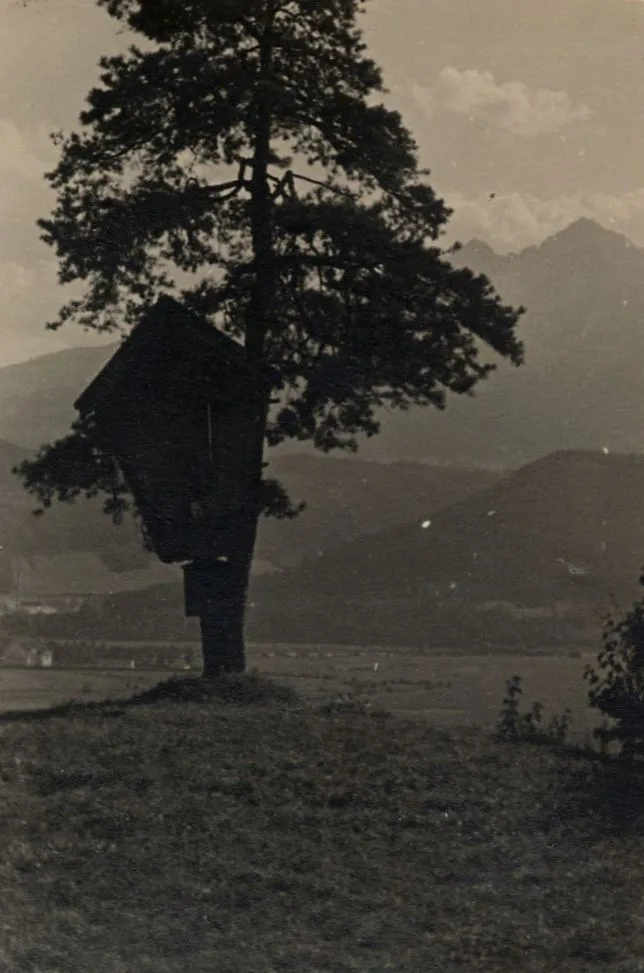
(Galgenbühel bei Hötting, ca. 1930. Als 1911 hier Grabungsarbeiten für die Mittenwaldbahn durchgeführt wurden, wurden einige menschliche Knochen zu Tage gefördert. Signatur Ph-31658)